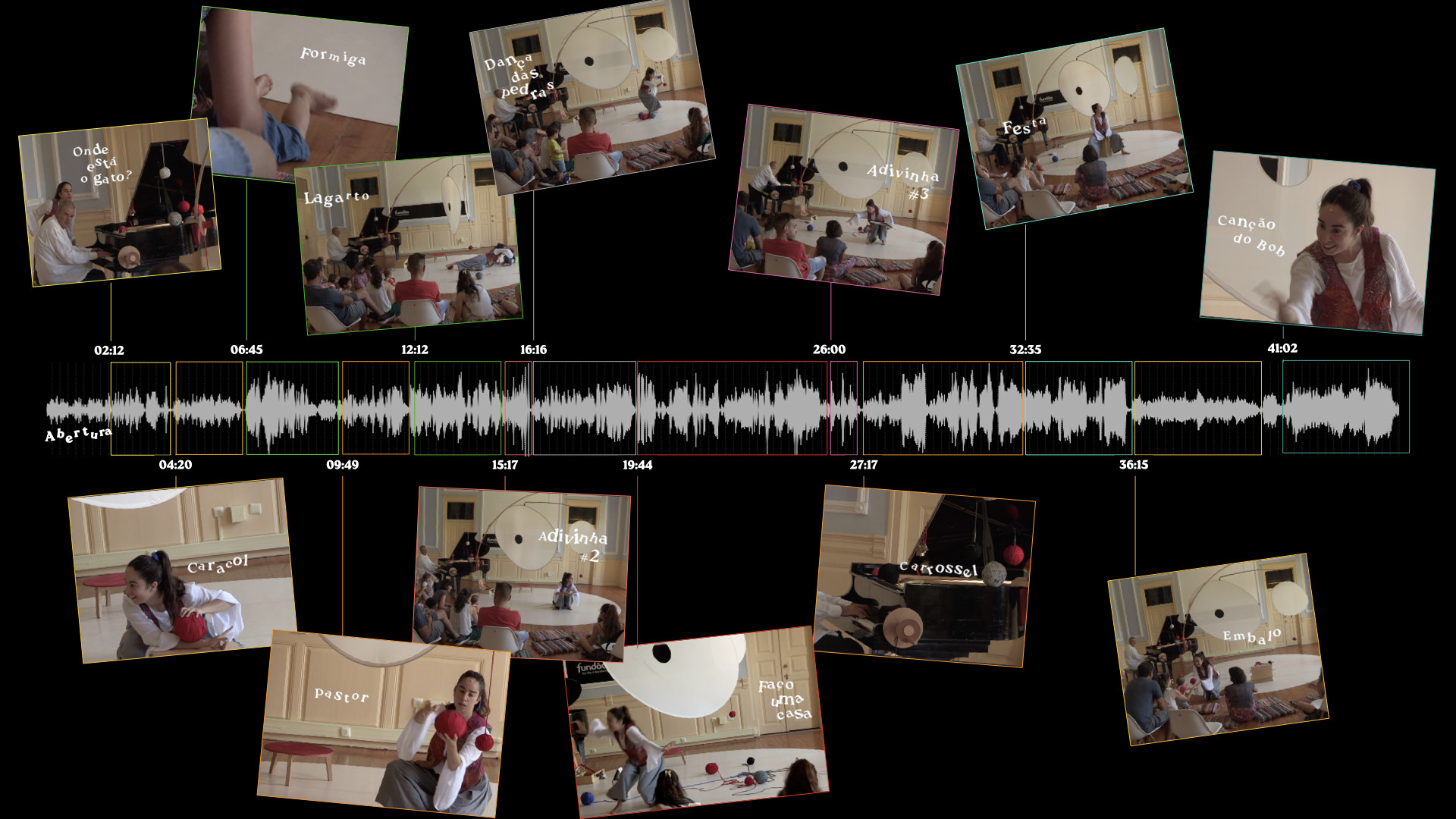
The performance of Dooo Ba Wooo at Sala das Conchas, Casino Fundanense, resulted in a complete video recording whose purpose is simultaneously enjoyment/contemplation and also analysis/reflection on essential aspects of artistic communication. Observing “what happens” in an artistic experience with young children has long sparked our interest. Works such as Bebê Babá included, in the final performance, images collected during the creative process, creating a relationship between the “here and now” and the memory of its construction, bringing to the stage an additional perspective on the relationship between parents, artists, and babies. What began as perhaps an intrinsically aesthetic motivation gradually took on a scientific and educational slant as well: the images collected over several years, and in various projects, were the origin of works that aimed to describe and understand how babies, young children, and parents/caregivers relate to music, movement, scenic elements, and performers during a performance or workshop. This knowledge was important for our own development but soon it became relevant as a way to refine the observational skills of parents, students, and professionals in the arts and education we work with. The term “Tuning the Seeing” was originally used to name a series of workshops developed within the Opus Tutti Project, in which a group of parents of young children used photography as a way to develop acuity, sensitivity, and attention to the development of young children and to aspects of the parent-child relationship.
The idea of Tuning is central to CMT’s work, and after this initial initiative, Tuning the Seeing (or Tuning of Sight) came to refer to a more generic idea that could be applied to other situations, namely using video and audio recordings. Naturalistic or ecological observation, that is, in “real” or “natural” contexts, has become a particularly interesting way to create opportunities for interdisciplinary crossover, to promote dialogue between Art and Science, to construct a “comprehensive seeing” that emerges from the intertwining the gaze of the artist, creator, interpreter, researcher, educator, observer, participant, and allows for a broader understanding of the World. It is a different paradigm from the “controlled environment” of baby labs or from research paradigms based on the idea of the observer as someone “external,” “independent”, without “emotional ties,” or “embodied knowledge” of what they observe. It is not, relevant, to have here an “epistemological” discussion about research methodologies and the consequent advantages, disadvantages, and limitations of the different approaches with which one can “see” the World. CMTeca has a designated collection called “Sight Tuning,” built from short video excerpts from various projects that seek to communicate recurring aspects grouped into concepts such as exploratory actions, attention, emotional expressions, imitation, body movement, vocalizations, interactions, among others. Additionally, it was possible (also within the scope of the Opus Tutti Project) to conduct a study based on video microanalysis on the behavior of 8 babies during a performance of AliBaBach . The study sought to identify and code some manifestations associated with the babies’ engagement during the performance, and the results were reported in the paper “Babies’ Engagement in Music Theatre Performances: A Microanalytical Study of Aesthetic Experiences in Early Childhood.”
With the video recording of Dooo Ba Wooo, we want to continue exploring the possibility of tuning seeing. Of becoming more sensitive, more informed, more curious. The full video (approximately 46 minutes) can obviously be seen as a complete record of the performance, and we believe it reflects very well the nature of what happened in Fundão and what happens in many CMT performances: a relationship with the audience built from musical, theatrical, and scenic elements, a way of “being in art” based on listening and sharing, on the possibility of interaction. The full video was also divided into “moments” that correspond to the musical-theatrical script. The partial videos are linear sequences that allow us to observe excerpts with approximate durations between 1 and 6 minutes and that include different contrasting “proposals” (songs, rhythmic chants, instrumental music, theatrical actions, choreography, etc.). In turn, each of these moments has its own “narrative,” its own “characters,” its own “expositions,” “suspensions,” “tensions,” and “resolutions.”
By proposing that Dooo Ba Wooo can be seen as a set of autonomous pieces, we are trying to promote the exercise of heightened attention, of the detail revealed in repetition, in viewing without sound, in listening without image, in the possibility of observing at different speeds of reproduction. It is an invitation we extend to artists, educators, and students to embark on a journey of discovery and construct their own way of seeing, and from there, their “understanding” and “creative tools.” The tuning of seeing is an important exercise in the era of “image saturation,” of fleeting and superficial attention, and we believe that Dooo Ba Wooo allows for a personal “journey” where facts and conjectures can engage in fruitful dialogue. There are no strict rules, but there is some advice we can offer: it is an exercise in fine-tuning, developing, and refining attention. And as such, it requires time. Repetition. Some basic conditions of listening and visualization. Whole, Part, Whole. The constant questioning of what is seen and heard: who is acting? who is reacting? where is the focus of the action? what is foreground and background? how is the web woven that involves performers and audience? how is each image or performative action constructed? what is the role of the body, of the scenic elements? how was the “space” “interpreted”? what is “continuity,” “rupture,” “contrast,” “waiting”? what is heard? what happens in moments of “silence”? what are “silences” made of?
Have a good journey!